



The landscape of pharmacy in New South Wales is about to undergo significant reform. In addition to expanding the scope of practice for pharmacists who undergo the requisite training, the reforms will introduce significant changes to the framework governing the prescribing, supply and distribution of medicines.
From 5 November 2026, the Medicines, Poisons and Therapeutic Goods Act 2022 (NSW) and Medicines, Poisons and Therapeutic Goods Regulation 2026 (NSW) will come into effect.[1]
The new legislation is more prescriptive and identifies the protection of public health and safety as the paramount consideration.[2] The changes will affect not only the day-to-day work of employed pharmacists, but also the responsibilities of pharmacy proprietors and business owners.
Administrative and operational changes for pharmacists
The new legislative framework introduces a range of operational changes for pharmacists, including:
- Removal of the requirement for a pharmacist to personally and physically hand over Schedule 3 (Pharmacy Only) medications. The pharmacist must, however, still provide verbal or written instructions about the use of the substance at the time of supply and comply with the other applicable legislative requirements.
- Pseudoephedrine will be treated as a Schedule 3 (Pharmacy Only) medication.
- An extension of time for a pharmacist to notify the Ministry of Health if a doctor provides an oral direction for a drug of addiction and does not provide a prescription within 14 days[3].
- A pharmacist who dispenses a Schedule 8 medication (with the exception of Opioid Treatment Program (OTP) prescriptions) will no longer be required to keep a paper prescription if there are remaining repeats. Paper repeats can be returned to the patient.
- Introduction of the concept of an ‘explained loss’. This removes the requirement to report certain accidental or expected losses of Schedule 4D or Schedule 8 medicines to the Pharmaceutical Services Unit (PSU) within the Ministry of Health. Only theft, loss or prescribed events need to be reported.
- Simplified terminology for Schedule 4D and Schedule 8 medications, including:
- prescribed restricted substances will now be referred to as Schedule 4D medications
- a special restricted substance will now be referred to as a Schedule 4D substance that is an anabolic-androgenic steroidal substance, and
- drugs of addiction will now be referred to as Schedule 8 medications.
Proprietor oversight and responsibility
The new legislative regime will significantly affect pharmacy proprietors, who will assume greater day-to-day responsibility for ensuring compliance with the regulatory framework, particularly regarding entries in the drug registers.[4]
-
- The responsibility for ensuring entries are made and maintained in the drug register will shift from ‘a person who has possession of drugs of addiction at any place’, often the pharmacist in charge for that day, to ‘the holder of a financial interest, within the meaning of the Health Practitioner Regulation National Law (NSW), Schedule 5F, in the pharmacy’. In practical terms, this means responsibility will rest with the proprietor.
- The responsibility for compliance with legislative storage requirements will also shift to the proprietor.
Proprietors involved in the OTP should pay particular attention to how the new legislative framework will alter the way the program operates, as this is routinely an area of focus for the PSU.
Penalties for non-compliance
Under the previous regime, offences attracted penalty units or statutory sentencing limits.[5] The new regime introduces a tiered penalty system that groups financial penalty units and, where applicable, maximum terms of imprisonment within a defined tier, and then allocates the tier to each offence.
The maximum penalties applicable to individuals and corporations under each tier are summarised below.[6]
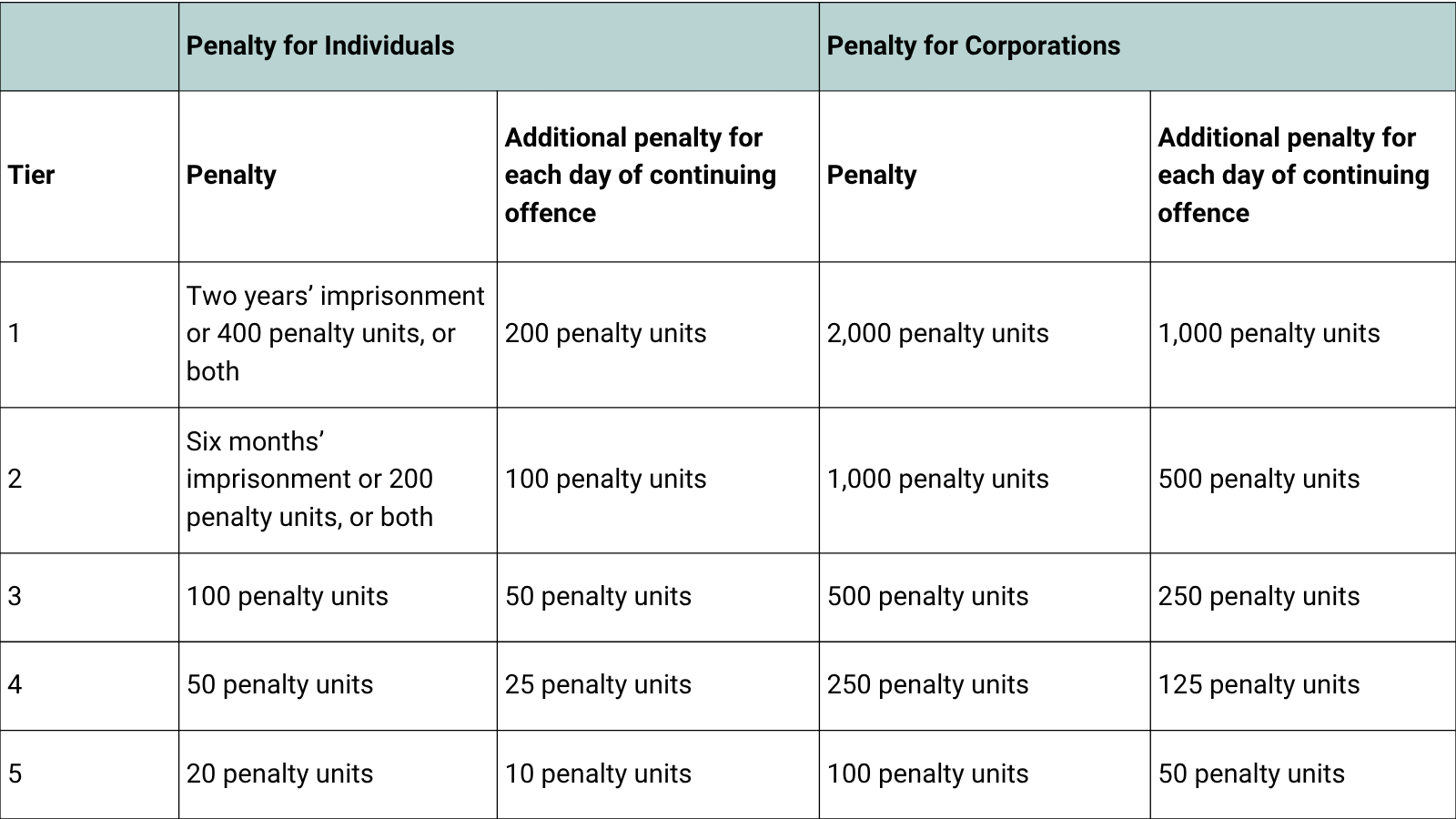
Two features of the new penalty framework are particularly important:
- The higher the tier number, the less serious the offence and the lower the applicable maximum penalty. Higher penalties apply to corporations for continuing offences.
- Proprietors operating through a corporate entity under Schedule 5F of the Health Practitioner Regulation National Law (NSW) should be aware that the financial penalties for corporations are up to five times greater than those for individuals.
The PSU routinely inspects pharmacies to assess compliance with relevant legislation and regulations. Pharmacists and proprietors should monitor the implementation of the new framework closely. Practitioners are also encouraged to seek timely advice from their professional indemnity insurers and advisors about the changes and to complete any relevant continuing professional development.
This article was written by Solicitor Sophie Hawkins-Adams and Principal Lawyer Joanne Hayes. Please contact Joanne if you have any questions or would like more information.
 Meet our Team
 View our Insights