



Background
Paramedicine became a nationally regulated health profession on 1 December 2018, when paramedics joined the National Registration and Accreditation Scheme. Since that date, paramedics have been subject to national registration requirements and regulated by the Paramedicine Board of Australia under the Health Practitioner Regulation National Law, with support from the Australian Health Practitioner Regulation Agency (AHPRA).
The Queensland Civil and Administrative Tribunal’s recent decisions in Health Ombudsman v Cole [2026] QCAT 10 (Cole) and Health Ombudsman v Hastings [2026] QCAT 139 (Hastings) are among the first published Queensland disciplinary decisions concerning registered paramedics. They provide important guidance about how QCAT may characterise delays in responding to emergency callouts and failures to promptly notify an ambulance service’s operational centre of a paramedic’s movements.
The decisions also demonstrate that similar conduct can result in different disciplinary findings and sanctions, depending on the nature of the incidents and the practitioner’s personal and professional circumstances.
Under the National Law, disciplinary conduct may be characterised according to its nature and seriousness, including as unsatisfactory professional performance (low range), unprofessional conduct (mid-range) or professional misconduct (most serious).
Health Ombudsman v Cole [2026] QCAT 10
The respondent in Cole was a registered paramedic employed by the Queensland Ambulance Service (QAS). The allegations concerned two categories of conduct:
- delays of between four and 37 minutes in notifying the QAS Operations Centre of her movements after completing callouts, and
- delays in responding to a Code 2B incident and a Code 1B incident.[1]
Delays in notifying the Operations Centre
The Tribunal characterised the delays in notifying the Operations Centre as unsatisfactory professional performance.
Although the failures could have affected the allocation of QAS resources, no actual disruption occurred. The Tribunal considered the failures to be administrative in nature, rather than conduct falling materially below the standard expected of a paramedic.
Delayed responses to callouts
The Tribunal characterised the shorter Code 2B incident as unprofessional conduct. The actual delay was likely to have been two to three minutes. The respondent had not intentionally delayed her response and no adverse consequences followed.
The Tribunal reached a different conclusion about the Code 1B incident. After signing on for duty, the respondent stopped to purchase coffee. She continued waiting for it after receiving the dispatch, delaying her response by approximately 10 minutes.
The Tribunal found that this conduct constituted professional misconduct. It described the incident as a serious failure to respond and concluded that, viewed objectively, there could be “no room for doubt” about its characterisation.
Sanction
The Tribunal imposed:
- a caution for the unsatisfactory professional performance and unprofessional conduct, and
- a reprimand (a formal and publicly recorded disciplinary sanction) for the professional misconduct.
In determining the appropriate sanction, the Tribunal considered the respondent’s insight, remorse, cooperation, further education and remediation, previous internal disciplinary action and absence of similar conduct before or after the incidents.
It also strongly recommended that the Paramedicine Board remove the reprimand from the public register after four months.
Health Ombudsman v Hastings [2026] QCAT 139
The respondent in Hastings was an Advanced Care Paramedic employed by QAS. As in Cole, the allegations concerned two categories of conduct:
- delays in notifying the QAS Operations Centre of his movements after completing callouts, and
- delays in responding to emergency callouts.
Delays in notifying the Operations Centre
Consistent with its approach in Cole, the Tribunal characterised the delays in notifying the Operations Centre as unsatisfactory professional performance.
These failures largely concerned compliance with QAS operational and administrative requirements, rather than direct delays in responding to patients.
Delayed responses to callouts
The respondent delayed responding to three Code 1 incidents:
- by approximately 10 minutes while detouring to his home
- by approximately three to five minutes while waiting for food and coffee at McDonald’s, and
- by approximately 15 minutes while purchasing coffee.
The Tribunal observed that the three-to-five-minute delay, if considered in isolation, may only have warranted a finding of unsatisfactory professional performance.
However, the Tribunal found that each of the three delays amounted to unprofessional conduct. When considered together, all of the incidents constituted professional misconduct under the National Law.
This aspect of the decision is significant. Conduct that may attract a lower characterisation when viewed in isolation can constitute professional misconduct when it is repeated conduct.
Sanction
Unlike in Cole, the Tribunal imposed a caution for both the unsatisfactory professional performance and the professional misconduct.
The Tribunal rejected the proposition that a reprimand must follow every finding of professional misconduct. Instead, it determined the appropriate sanction by reference to the particular facts and mitigating circumstances.
Those circumstances included the respondent’s:
- stress and health difficulties
- heavy workload and missed meal breaks
- insight and re-education
- previous internal QAS disciplinary action
- return to his usual duties
- absence of other disciplinary history, and
- exemplary references.
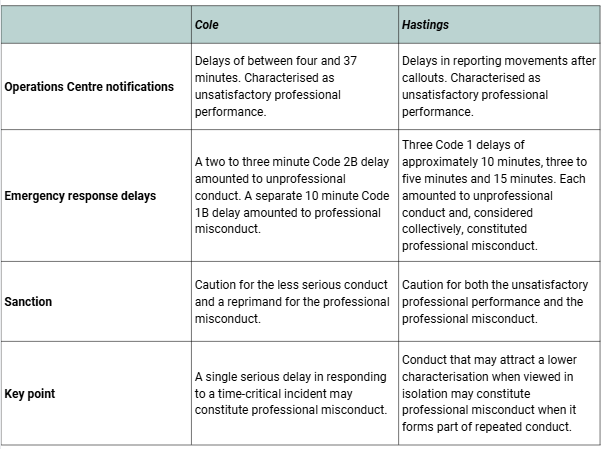
Cole and Hastings: key findings compared
The following table highlights the principal similarities and differences between the two decisions.
What do these decisions mean for paramedics?
Cole and Hastings confirm that delays in responding to emergency callouts can result in disciplinary findings even where no patient suffers harm.
A short delay may amount to unsatisfactory professional performance or unprofessional conduct. A more serious delay in responding to a time-critical incident may constitute professional misconduct. Multiple incidents that individually amount to unprofessional conduct may also constitute professional misconduct when considered together.
The decisions also distinguish between:
- operational or administrative failures, such as failing to promptly update the Operations Centre after completing a callout, and
- conduct that directly delays a response to an emergency dispatch.
QCAT treated delayed emergency responses more seriously because they create potential risks to patients and may undermine public confidence in the profession.
The decisions provide an important reminder that even relatively brief delays, including those caused by personal activities such as purchasing food or coffee, can expose paramedics to disciplinary action.
Paramedics should also recognise that internal disciplinary action does not prevent the same conduct from being investigated by the Health Ombudsman, and potentially referred to QCAT.
If concerns arise, evidence of insight, remediation, further training, subsequent safe practice and positive professional standing may materially affect the disciplinary outcome.
In practical terms, paramedics should:
- respond immediately to emergency dispatches and cease personal activities upon receiving a callout
- understand the operational codes used to record their whereabouts and availability
- promptly and accurately update the Operations Centre about their status, location and movements, and
- notify the Operations Centre if any circumstance affects their capacity to respond.
Looking ahead
Cole and Hastings provide early guidance on how QCAT may assess the operational conduct of registered paramedics. They also demonstrate that disciplinary findings and sanctions can vary depending on the circumstances of the conduct and the practitioner.
Most importantly, the decisions reinforce the need for paramedics to respond promptly to callouts, maintain accurate operational communications and address any identified shortcomings at an early stage.
This article was written by Associate Won Jang and Principal Lawyer Scott Ames. If you would like advice about a notification, investigation or disciplinary proceeding involving a paramedic, please contact Won or Scott.
Disclaimer: This information is current as of November 2026. This article does not constitute legal advice and does not give rise to any solicitor/client relationship between Meridian Lawyers and the reader. Professional legal advice should be sought before acting or relying upon the content of this article.
[1] A Code 1B incident requires an emergent, time-critical response. A Code 2B incident is a lower-acuity case that does not require a response under lights and sirens.
 Meet our Team
 View our Insights